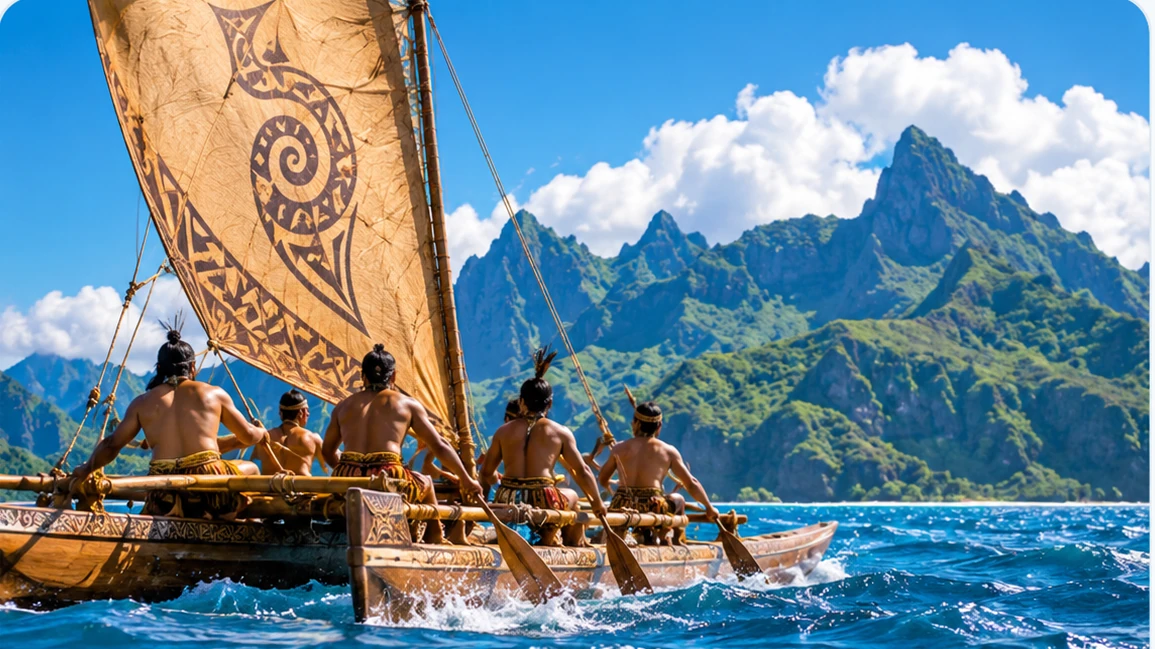
Illustrated scene of Polynesian voyaging across the Pacific.
Free levelled English reading practice. Read for meaning first, then use the full Speed Reading tool to time yourself and track your progress.
Long before European ships entered the central Pacific, Polynesian navigators had settled islands scattered across millions of square kilometres of ocean. Their achievements did not depend on modern instruments. Navigators developed sophisticated bodies of knowledge involving stars, swell patterns, winds, clouds, birds and the behaviour of reflected light near islands. Settlement proceeded over generations from western Polynesia into remote archipelagos including Hawai‘i, Rapa Nui and Aotearoa New Zealand. Archaeology, linguistics and genetics broadly support origins connected to Austronesian-speaking peoples moving through Island Southeast Asia and the western Pacific, while evidence also reveals interaction with Papuan populations. Revivals of traditional voyaging, including journeys by double-hulled canoes, have demonstrated that non-instrument navigation is a rigorous learned system rather than accidental drifting.