1Lesson Goals
I will be able to:
- retell the main events.
- use at least three new words.
- complete the language task.
- support an answer with evidence.
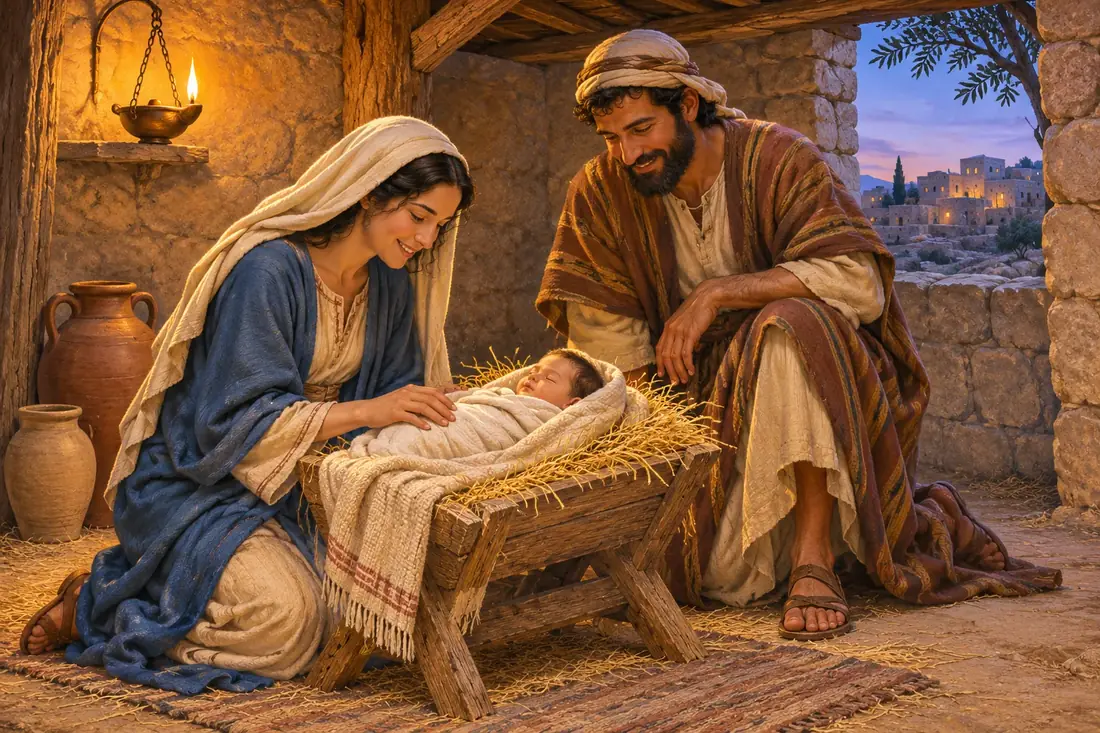
Start here: Look at the picture. What might people need when they are far from home?
Good news in Bethlehem; practise there was and there were.
Name: ____________________________ Date: ________________ Student worksheet · 1 / 2
I will be able to:
Start here: Look at the picture. What might people need when they are far from home?
The emperor ordered a census: people had to register in their family towns. Joseph travelled from Nazareth to Bethlehem with Mary, who was expecting a baby. While they were there, Mary gave birth to her son, Jesus. She wrapped him in cloths and laid him in a manger, a box used to feed animals. There was no room for them in the lodging place.
That night, shepherds were looking after their sheep in nearby fields. An angel appeared, and they were frightened. The angel told them not to be afraid. A Saviour, Christ the Lord, had been born in Bethlehem. They would find a baby wrapped in cloths and lying in a manger. Many angels then praised God.
The shepherds hurried to Bethlehem. They found Mary, Joseph and the baby, just as the angel had said. They told others the good news. Mary remembered these things and thought about them carefully. The shepherds returned to their sheep, praising God for what they had heard and seen.
Simplified retelling for English learners; not a direct Bible quotation. Based on Luke 2:1–20. AI illustration.
Read the additional reading sheet.
Read the text after the two activity pages. Underline details that support your answers.
Words and ideas to remember
Match 1–6 with A–F.
A. a person who looks after sheep
B. say that someone is wonderful or good
C. a count and registration of people
D. move or do something quickly
E. a messenger from God
F. a box for feeding animals
Use two words in your own sentences.
Answer in sentences where you can. Point to evidence in the reading.
Use there was with one thing or an uncountable noun. Use there were with more than one. Example: There was a baby. There were shepherds.
Discuss in pairs. Give a reason for each answer.
Useful language: There was… / There were… / They told…
You may use imagined examples.
Name: ____________________________ Date: ________________ Student worksheet · 2 / 2
Write 40–60 words about the night in Bethlehem. Include two sentences with there was and two with there were.
Plan: Who? What happened? What was the result?
Check capitals, verbs, spelling and punctuation.
Put the events in order: A. The shepherds found the baby. B. Joseph and Mary travelled to Bethlehem. C. The angel spoke to the shepherds. D. Mary gave birth to Jesus. Retell them to a partner.
Extra challenge: Explain your answers in complete sentences.
Exit reflection: One thing I learned…
One thing I want to practise…
Tell the story in 4–5 sentences. Include where Jesus was born, who heard the news and how they responded.
Write below or prepare a 45-second spoken response. Use your own words.
The emperor ordered a census: people had to register in their family towns. Joseph travelled from Nazareth to Bethlehem with Mary, who was expecting a baby. While they were there, Mary gave birth to her son, Jesus. She wrapped him in cloths and laid him in a manger, a box used to feed animals. There was no room for them in the lodging place.
That night, shepherds were looking after their sheep in nearby fields. An angel appeared, and they were frightened. The angel told them not to be afraid. A Saviour, Christ the Lord, had been born in Bethlehem. They would find a baby wrapped in cloths and lying in a manger. Many angels then praised God.
The shepherds hurried to Bethlehem. They found Mary, Joseph and the baby, just as the angel had said. They told others the good news. Mary remembered these things and thought about them carefully. The shepherds returned to their sheep, praising God for what they had heard and seen.
Simplified retelling for English learners; not a direct Bible quotation. Based on Luke 2:1–20. AI illustration.
When you have finished this activity, mark it complete.
I’ve finished this activity ✓