1Lesson Goals
I will be able to:
- retell the main events.
- use at least three new words.
- complete the language task.
- support an answer with evidence.
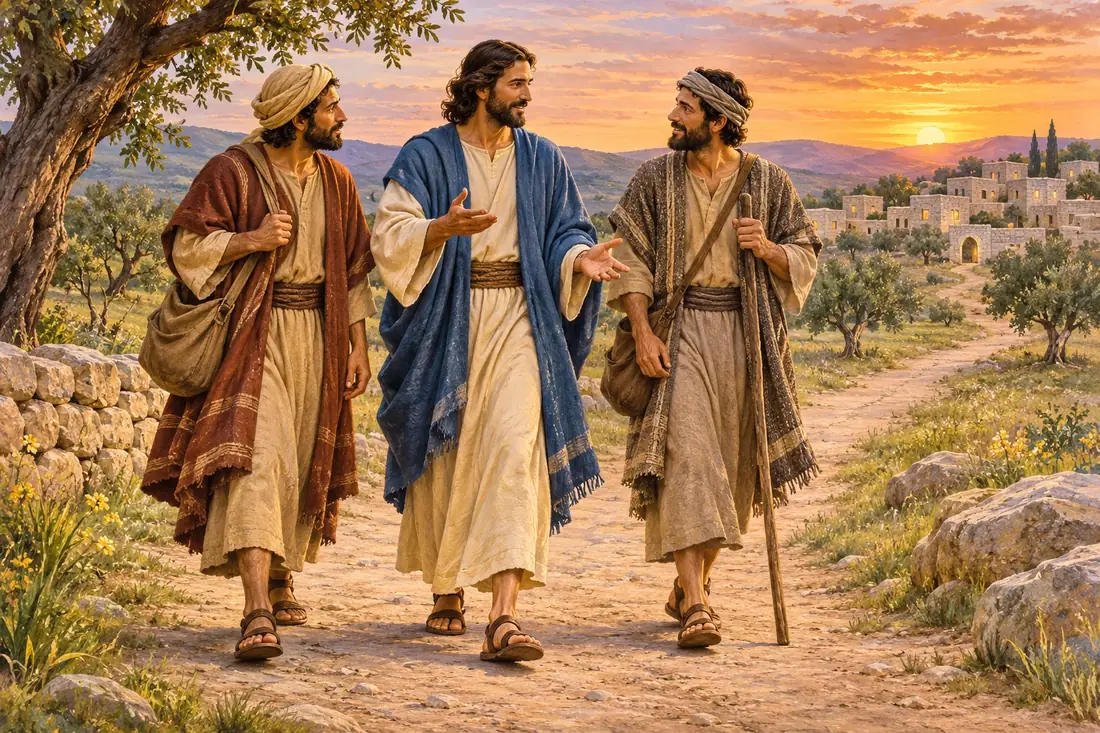
Start here: Look at the picture. How can a conversation change someone’s understanding?
A surprising meeting after the resurrection; practise past continuous and past simple.
The Resurrection of Jesus Christ · StoryVerse
Watch this companion video before reading Luke 24:13–35. The Road to Emmaus lesson begins after the resurrection.
▶ Watch on YouTube ↗Listen for this: What happens on the third day?
Watch once for the story, then listen again for three English words you recognise. Use captions or a slower playback speed if available.
Name: ____________________________ Date: ________________ Student worksheet · 1 / 2
I will be able to:
Start here: Look at the picture. How can a conversation change someone’s understanding?
On the day Jesus rose from the dead, two of his followers were walking from Jerusalem to Emmaus. One was called Cleopas. They were talking sadly about Jesus' death and reports that his tomb was empty. Jesus joined them, but they did not recognise him.
Jesus asked what they were discussing. They explained that they had hoped Jesus would rescue Israel. Some women had visited the tomb and reported seeing angels who said he was alive. Jesus explained the Scriptures to the travellers. He showed them that the Messiah had to suffer before entering his glory.
Near Emmaus, the travellers invited him to stay because evening was coming. At the table, he took bread, gave thanks, broke it and gave it to them. Then they recognised him, and he disappeared from their sight. They remembered how deeply his words had moved them on the road. They returned to Jerusalem that same hour and told the other followers how they had recognised Jesus when he broke the bread.
Simplified retelling for English learners; not a direct Bible quotation. Based on Luke 24:13–35. AI illustration.
Read the additional reading sheet.
Read the text after the two activity pages. Underline details that support your answers.
Words and ideas to remember
Match 1–6 with A–F.
A. ask someone to come or stay
B. know who someone is when you see them
C. a place where a dead person is buried
D. become impossible to see
E. a person who follows a teacher or leader
F. the sacred writings of the Bible
Use two words in your own sentences.
Answer in sentences where you can. Point to evidence in the reading.
Use past continuous for an action in progress and past simple for an event during it. Example: They were walking when Jesus joined them.
Discuss in pairs. Give a reason for each answer.
Useful language: At first they thought… / They later realised… / The evidence is…
You may use imagined examples.
Name: ____________________________ Date: ________________ Student worksheet · 2 / 2
Write 60–80 words as one of the travellers describing the day. Include two sentences combining past continuous and past simple. Keep the details consistent with the reading.
Plan: Who? What happened? What was the result?
Check capitals, verbs, spelling and punctuation.
Rebuild the journey: put A–E in order. A. They recognised Jesus. B. They invited him to stay. C. Jesus explained the Scriptures. D. Two followers left Jerusalem. E. They returned to Jerusalem. Add one sentence for each event.
Extra challenge: Explain your answers in complete sentences.
Exit reflection: One thing I learned…
One thing I want to practise…
Explain how the travellers’ understanding changed during the story. Write 5–6 sentences and support your answer with two events.
Write below or prepare a 45-second spoken response. Use your own words.
On the day Jesus rose from the dead, two of his followers were walking from Jerusalem to Emmaus. One was called Cleopas. They were talking sadly about Jesus' death and reports that his tomb was empty. Jesus joined them, but they did not recognise him.
Jesus asked what they were discussing. They explained that they had hoped Jesus would rescue Israel. Some women had visited the tomb and reported seeing angels who said he was alive. Jesus explained the Scriptures to the travellers. He showed them that the Messiah had to suffer before entering his glory.
Near Emmaus, the travellers invited him to stay because evening was coming. At the table, he took bread, gave thanks, broke it and gave it to them. Then they recognised him, and he disappeared from their sight. They remembered how deeply his words had moved them on the road. They returned to Jerusalem that same hour and told the other followers how they had recognised Jesus when he broke the bread.
Simplified retelling for English learners; not a direct Bible quotation. Based on Luke 24:13–35. AI illustration.
When you have finished this activity, mark it complete.
I’ve finished this activity ✓