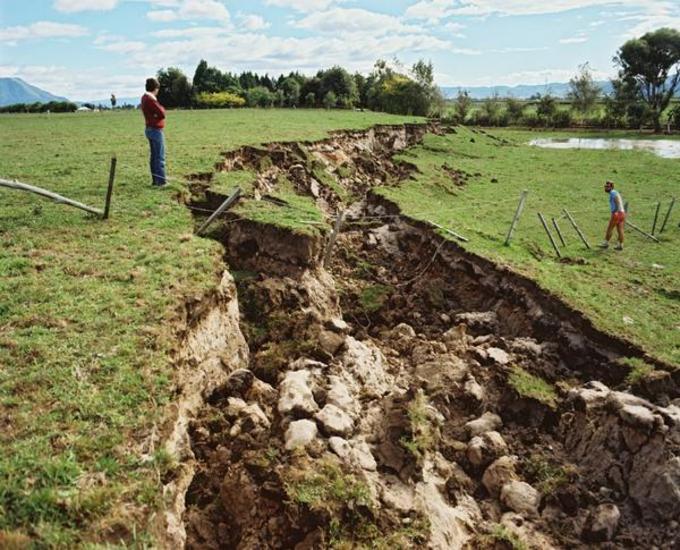
Earthquake surface rupture. Photo: GeoNet New Zealand.
Free levelled English reading practice. Read for meaning first, then use the full Speed Reading tool to time yourself and track your progress.
Earthquakes occur when accumulated stress in Earth's crust is released suddenly, usually as rocks slip along a fault. Tectonic plates move continuously, but friction can lock sections of a fault for years, decades or centuries. As deformation builds, the rocks eventually rupture, sending seismic waves through the planet. Instruments called seismometers record these waves, allowing scientists to estimate an earthquake's location, depth and magnitude. The amount of damage, however, depends on more than magnitude. Building design, ground conditions, distance from the fault, depth of rupture and population density can all influence the consequences. Scientists can identify hazardous faults and estimate long-term probabilities, but they cannot reliably predict the exact time and place of a major earthquake. Modern risk reduction therefore focuses on resilient construction, land-use planning, early-warning systems where feasible, and public preparedness. Earthquake science is a reminder that understanding a natural process does not necessarily mean being able to forecast each individual event.
Comprehension questions
What causes most earthquakes?
Why can a fault remain locked?
What do seismometers record?
Why does magnitude alone not determine damage?
What is the main focus of modern earthquake risk reduction?