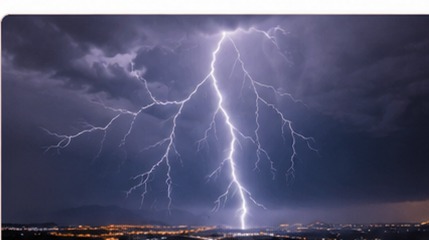
Lightning during a thunderstorm. EnglishDrills.org illustration.
Free levelled English reading practice. Read for meaning first, then use the full Speed Reading tool to time yourself and track your progress.
Inside a large thunderstorm cloud, powerful air currents move water droplets, ice crystals and small pieces of hail up and down. As these particles collide, electrical charges become separated. Different parts of the cloud develop different charges, creating a strong electric field. Usually, the lower part of a thundercloud becomes mainly negatively charged while the ground below can become positively charged. When the electrical difference becomes great enough, the air can no longer act as an effective insulator. A channel of charged particles begins to form. In cloud-to-ground lightning, a faint branching path called a stepped leader moves downward from the cloud. As it approaches the ground, upward-moving electrical streamers may rise from tall objects. When the paths connect, a powerful electrical current travels through the channel. This produces the brilliant flash we see as lightning. The air around the channel becomes extremely hot and expands suddenly. That rapid expansion creates a shock wave that we hear as thunder. Light travels much faster than sound, which is why we normally see lightning before we hear the thunder that it produces.