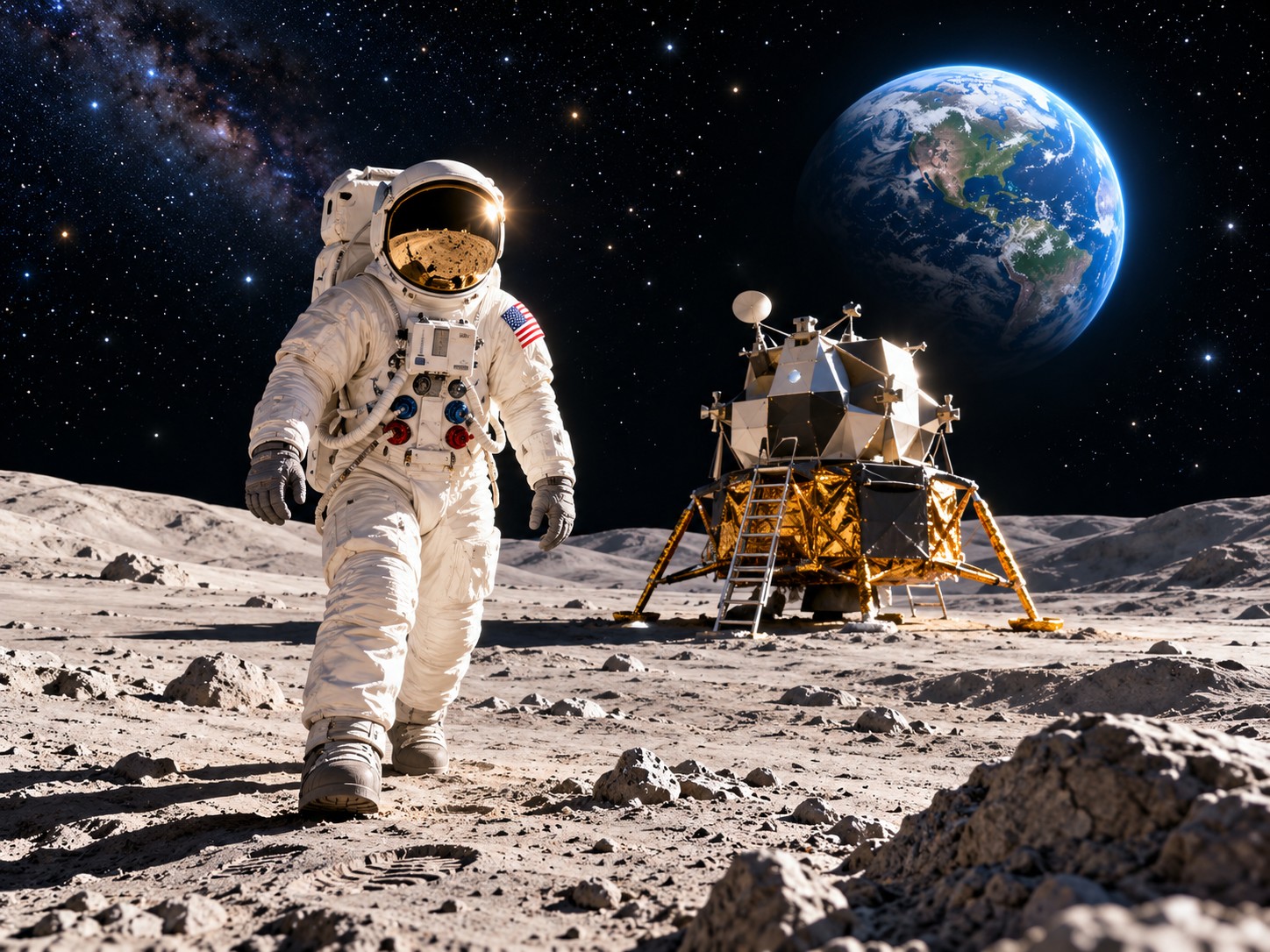
AI illustration of the Moon landing created for EnglishDrills.org.
Free levelled English reading practice. Read for meaning first, then use the full Speed Reading tool to time yourself and track your progress.
For thousands of years, people looked at the Moon and wondered what it would be like to stand on its surface. On 20 July 1969, that idea became reality. The Apollo 11 mission carried three American astronauts—Neil Armstrong, Buzz Aldrin and Michael Collins—to the Moon. The mission was the result of years of scientific research, engineering and intense competition between the United States and the Soviet Union during the Cold War. After entering lunar orbit, Armstrong and Aldrin moved into a small spacecraft called Eagle, while Collins remained in the command module Columbia. Eagle began its descent, but the landing was tense. The planned landing area contained dangerous rocks, so Armstrong took partial manual control and guided the spacecraft to a safer place. Fuel was running very low when Eagle finally touched down. Several hours later, Armstrong climbed down the ladder and became the first human to step onto the Moon. Aldrin joined him soon afterwards. The two astronauts spent about two and a half hours outside the spacecraft, taking photographs, setting up scientific equipment and collecting rocks and soil. Meanwhile, Collins continued orbiting above them. The astronauts later returned safely to Earth, bringing lunar samples that scientists could study. Apollo 11 was watched by an enormous international television audience and became one of the defining technological achievements of the twentieth century.