English Drills
Home › Teacher lessons › The Kon-Tiki Voyage

The Kon-Tiki Voyage

A complete A2 classroom lesson built around an engaging topic. Use it as a 45–60 minute lesson, or choose individual sections for a shorter class.

A250–60 minutesExplorationPrintable
Teacher lesson: Look at the picture and title. What do you already know about this topic? Write two ideas, then compare with a partner. Work through the nine panels in order, or choose the sections that suit your class. Teacher answers and the listening script are stored separately.
Teacher AnswersOpen related EnglishDrills reading
1 Lesson Goals
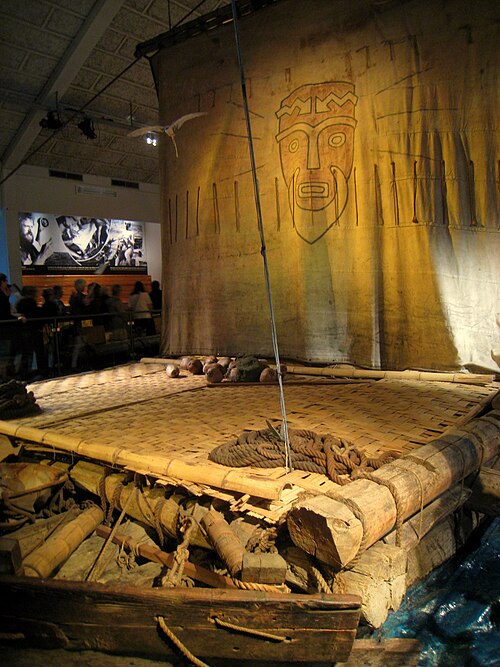
The Kon-Tiki raft

By the end of this lesson, I will be able to:

  • understand the main ideas and key details in The Kon-Tiki Voyage.
  • learn and use important vocabulary from the lesson.
  • use the lesson language in speaking or writing.
Start here: What do you already know about this topic? Tell a partner one idea.
2 Reading
Before you read:

Look at the picture and title. What do you already know about this topic? Write two ideas, then compare with a partner.

In 1947, Norwegian explorer Thor Heyerdahl and five companions sailed across the Pacific on a simple raft called Kon-Tiki. Heyerdahl wanted to test whether people from South America could have reached Polynesia long ago using materials and technology available at the time. The raft was built mainly from balsa wood. The crew left Peru and travelled west for more than three months. They depended on winds and ocean currents. After a journey of thousands of kilometres, the raft reached an island reef in the Tuamotu Islands. The voyage did not prove where Polynesian people came from, but it showed that a long journey on a traditional-style raft was possible.
3 Vocabulary
Words: explorer · raft · balsa · current · reef

Write a short meaning or synonym for each word.

explorer –

raft –

balsa –

current –

reef –

4 Check Your Understanding

1. When did the Kon-Tiki voyage happen?

2. How many companions travelled with Heyerdahl?

3. What was the raft mainly made from?

4. What helped move the raft?

5. What did the voyage show?

5 Language Focus

Put the verbs in the past simple.

1. The crew (leave) Peru.

2. They (depend) on winds and currents.

3. The raft (travel) for more than three months.

4. It finally (reach) an island reef.

6 Listen & Speak

Listen

Listen to your teacher. You will hear the text twice. Answer the questions.

1. What did the crew have to do together?

2. Name one thing they carried.

3. What did they observe?

4. What did they record?

Speak

Discuss with a partner or small group.

• Would you travel across an ocean on a raft?
• What qualities does an exploration team need?
• What would be the hardest part of a long sea journey?

7 Use Your English

Something New

Your group may take only five items on the raft. Choose them together and be ready to defend your choices to another group.

Write

Write 80–100 words describing the Kon-Tiki journey in order. Use first, next, then and finally.

8 Puzzle or Game
Draw, Mime or Describe

Choose a useful word from this lesson. Do not say the word. Draw it, mime it, or describe it. Your partner has three guesses.

Swap roles and play again with a different word.

9 Success Criteria ✓

Tick each statement when you can do it.

  • I can explain the main idea of the lesson.
  • I can use at least three new words correctly.
  • I can complete the language task.
  • I can share an idea in spoken or written English.

One thing I am proud of today:

10 Show What You Can Do
My final challenge: The Kon-Tiki Voyage

Plan: Write 5 useful words or ideas from the lesson, or make a quick labelled sketch.

Write: Write 5–7 sentences that show what you learned. Try to use at least 3 words from the Vocabulary panel.

Share: Explain your work to a partner for about 30 seconds.