1Lesson Goals
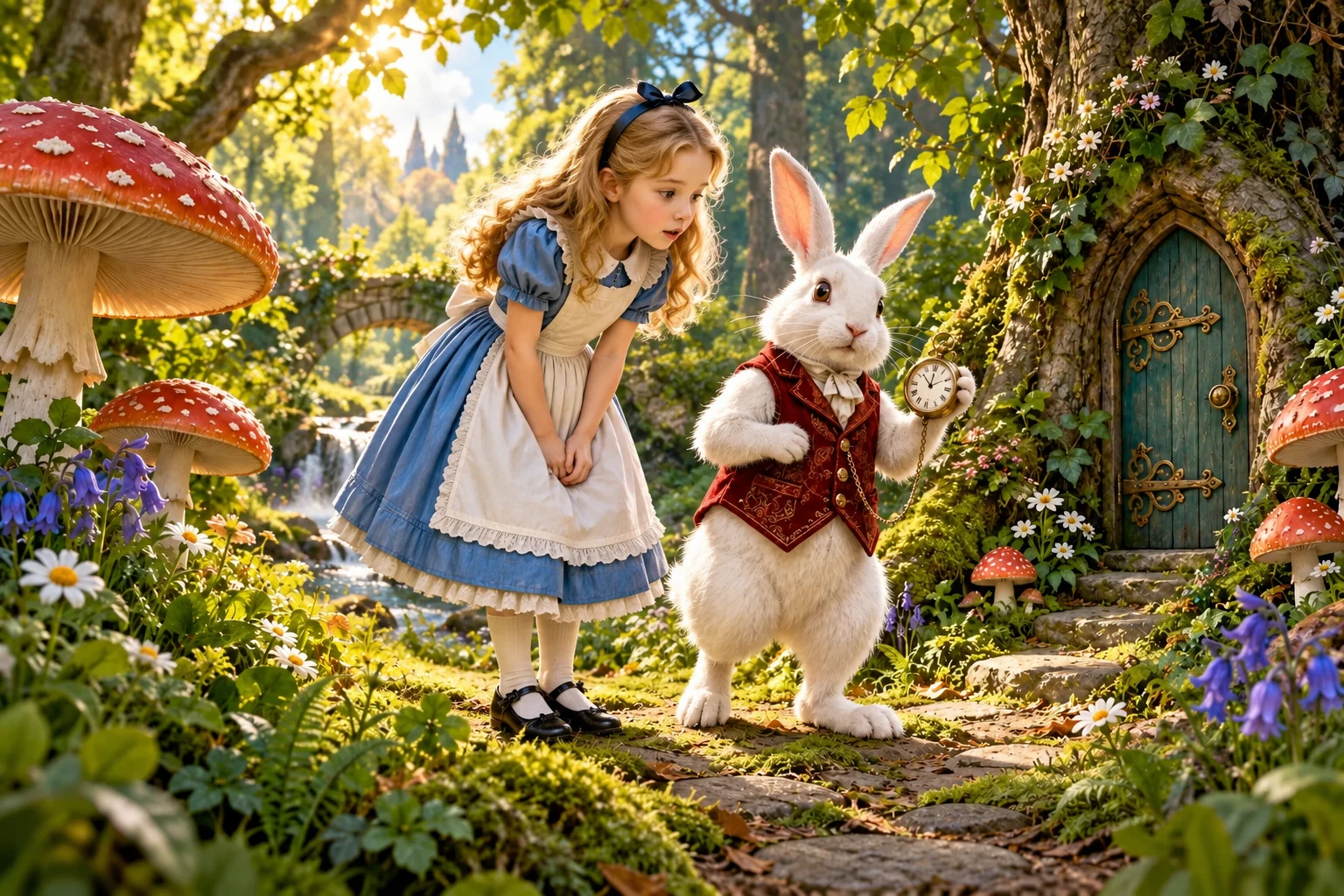
I will be able to:
- retell Alice’s adventure in order.
- use words about curiosity and imagination.
- use too and enough to explain problems.
- support an opinion with story evidence.
Start here: What would you ask a talking rabbit?
Lewis Carroll · Curiosity, imagination and strange rules
I will be able to:
Start here: What would you ask a talking rabbit?
Lewis Carroll’s Alice’s Adventures in Wonderland was published in 1865. Alice is sitting beside her sister when she notices a White Rabbit with a pocket watch. Curious, she follows it down a rabbit hole and enters a strange world.
In a hall, Alice finds a key to a tiny door. Beyond it is a beautiful garden, but she is too big to enter. A drink makes her smaller, yet now she is not tall enough to reach the key. Food and drink change her size again.
Alice meets a Caterpillar and a Cheshire Cat. At a tea party, the Hatter and the March Hare confuse her with unusual questions. She tries to understand them, but their conversations rarely follow ordinary rules.
Later, Alice joins the Queen of Hearts for a strange game of croquet. The Queen is quick to become angry. At a trial about stolen tarts, Alice challenges the unfair proceedings. Playing cards fly towards her, and she wakes beside her sister.
Wonderland was a dream. Its strange events invite readers to think about curiosity, identity and rules. Alice asks questions even when the answers do not make sense.
Original simplified overview; not a quotation. Read the original novel. AI illustration.
Match 1–6 with A–F.
A. to make someone unsure or unable to understand
B. who a person is
C. wanting to learn or know more
D. to question or disagree with something
E. to become smaller
F. not treating people equally or reasonably
Use two words in your own sentences.
Answer in sentences. Find evidence in the reading.
Too + adjective: more than is suitable. Alice is too big to enter.
Adjective + enough: as much as needed. She is not tall enough to reach the key.
Complete with too or enough.
Try it: Join using too: Alice is very big. She cannot enter the tiny door.
Discuss in pairs:
Useful language: I think… because… / For example… / I would… / On the other hand…
Listen to your partner and ask a follow-up question.
Alice in Wonderland — continued
Write 80–100 words. Choose one:
Use two vocabulary words, one sentence with too and one with enough.
Check sentence structure, capitals and punctuation.
Put these events in story order. Write the letters.
A. Alice challenges the trial.
B. Alice follows the White Rabbit.
C. Alice wakes beside her sister.
D. Alice finds the tiny door.
E. Alice goes to a confusing tea party.
Compare with a partner. Retell the story using first, next, later and finally.
Exit reflection: One idea I understand better…
One thing I want to practise…
Final challenge: Write 6–8 sentences, or prepare a one-minute spoken response, about how Alice responds to a strange world. Include two events, one opinion with evidence, and a sentence using too or enough.