English Drills
Home › Teacher lessons › Articles in Academic English: a, an, the and No Article

Articles in Academic English: a, an, the and No Article

A B1/B1+ lesson adapted from the EnglishDrills article practice, helping students choose a, an, the or no article by meaning rather than guesswork.

B155–60 minutesGrammar & academic readingPrintable
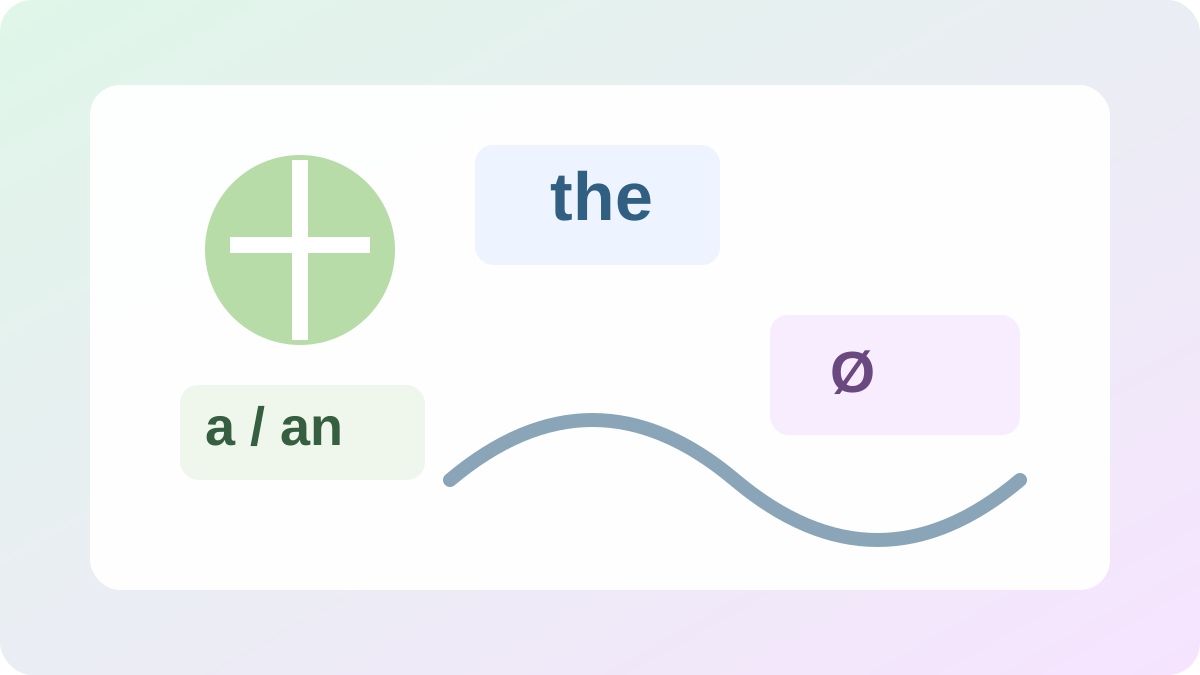
Teacher lesson: Look at the picture and title. What do you think today’s lesson will be about? Write two ideas and compare them with a partner. Work through the nine panels in order, or choose the sections that suit your class. Teacher answers and the listening script are stored separately.
Teacher Answers
1 Lesson Goals
Articles in Academic English: a, an, the and No Article

By the end of this lesson, I will be able to:

  • understand the main ideas and key details in Articles in Academic English: a, an, the and No Article.
  • learn and use important vocabulary from the lesson.
  • use the lesson language in speaking or writing.
Start here: What do you already know about this topic? Tell a partner one idea.
2 Reading
Before you read:

Look at the picture and title. What do you think today’s lesson will be about? Write two ideas and compare them with a partner.

In many cities around the world, trees are an important part of the urban environment. They provide shade, improve air quality and can make public spaces more pleasant. When we speak about trees in general, English often uses no article: Trees are important. When we introduce one example, we use a or an: A tree can provide shade.

We often use the when the listener or reader knows which thing we mean. For example, after we write a park, we can later write the park. Academic English also contains common patterns such as the environment, a significant effect and an important factor.

The best way to choose an article is to ask what the writer means. Is the noun general? Is it one new example? Or is it a specific thing already known? Thinking about meaning makes article use much more reliable.
3 Vocabulary

Match or explain these words from the lesson.

  • article — a small grammar word such as a, an or the
  • general — referring to a whole group or idea
  • specific — referring to one particular thing
  • introduce — mention something for the first time
  • environment — the natural or physical world around us
4 Check Your Understanding
1. Why is there no article before “trees” in “Trees are important”?
2. When do we normally use a or an?
3. Why can “a park” later become “the park”?
4. What question should students ask before choosing an article?
5. Give one academic phrase from the reading that uses “the”.
5 Language Focus

Choose the correct article: a, an, the or no article (Ø).

1. Choose: In many cities around world, trees improve air quality.
2. Choose: researcher studied how parks affect stress.
3. Choose: People often feel calmer when they spend time in nature.
4. Complete: We visited park yesterday. park had a large lake.
5. Write one sentence about technology in general with no article before the noun.
6 Listen & Speak

Listen

Listen to your teacher twice and answer.

1. What three choices does the teacher tell the class to consider?
2. Which article is used when a noun is introduced for the first time?
3. What happens when that noun is mentioned again?
4. What example does the teacher give with “solution”?

Speak

  • Which article is hardest for you: a/an, the, or no article? Why?
  • Explain the difference between “A teacher can help” and “Teachers can help”.
  • Make a short example using “a problem” and then “the problem”.
7 Use Your English

Something New

“Article Detective”: Work in pairs. One student writes five short noun phrases with missing articles. The partner chooses a/an, the or Ø and must explain the meaning behind each choice.

Write

Write 100–130 words about one benefit of parks, libraries or public transport. Underline every a/an and the, and circle three nouns that correctly use no article.

8 Puzzle or Game
Vocabulary Detective

Choose four words from the Vocabulary panel. Write a short clue for each word without writing the word itself. Swap with a partner and see how many you can guess.

Bonus: Use one of the words in a new sentence.

9 Success Criteria ✓

Tick each statement when you can do it.

  • I can explain the main idea of the lesson.
  • I can use at least three new words correctly.
  • I can complete the language task.
  • I can share an idea in spoken or written English.

One thing I am proud of today:

10 Show What You Can Do
Final challenge: Articles in Academic English: a, an, the and No Article

Plan: Note your strongest idea, 3 useful words or phrases, and one supporting detail from the lesson.

Respond: Write a short paragraph of 6–8 sentences, or prepare a 45-second spoken response, showing what you learned.

Reflect: Underline the part of your response that best shows your progress.