
I will be able to:
- summarise Odysseus’s journey home.
- use vocabulary about adventures.
- describe past actions and background events.
- support an opinion about a character.
Start here: What might someone miss during a long journey away from home?
Homer · Adventure, loyalty and the journey home

I will be able to:
Start here: What might someone miss during a long journey away from home?
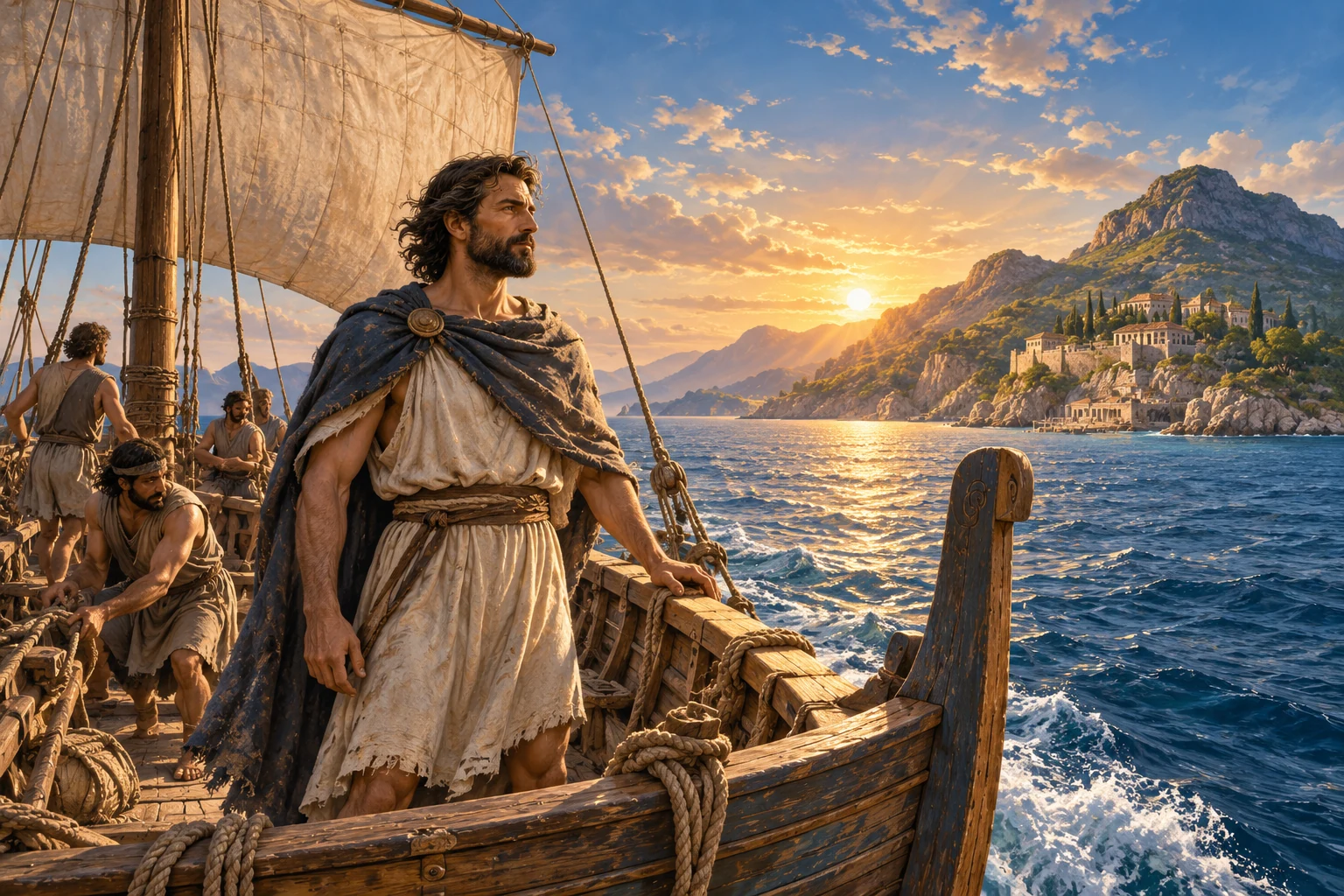
The Odyssey is an ancient Greek epic poem traditionally attributed to Homer. An epic is a long poem about important events and extraordinary adventures. Its hero, Odysseus, is trying to return to Ithaca after the Trojan War.
His journey home takes ten years. He faces storms, monsters and difficult choices. In one famous episode, the one-eyed Cyclops Polyphemus traps him and his men in a cave. Odysseus uses a clever plan to escape, but afterwards he proudly reveals his name. This creates further danger.
Later, the sailors pass the Sirens, whose beautiful songs tempt travellers towards danger. The men put wax in their ears. Odysseus wants to hear the songs, so he has himself tied to the mast. While the sailors are rowing, he listens without being able to leave the ship.
At home, his wife Penelope faces men who want to marry her and take his place. His son Telemachus searches for news of him. Odysseus eventually returns, overcomes the men threatening his household and reunites with his family.
The poem explores homecoming, loyalty, cleverness and pride. Odysseus is resourceful, but his decisions are not always wise.
Original simplified overview; not a quotation. Read The Odyssey at Project Gutenberg. AI illustration.
Match 1–6 with A–F.
A. a meeting after being apart
B. able to find ways to solve problems
C. a long poem about major events or heroic adventures
D. a strong wish to do something that may be unwise
E. continued support for someone or something
F. a long journey, especially by sea
Use two words in your own sentences.
Answer in sentences. Find evidence in the reading.
Past continuous: was/were + -ing describes an action in progress. Past simple describes a completed event.
Complete the verbs in this imagined scene inspired by the story.
Discuss in pairs:
Useful language: I think… because… / The reading shows… / Although he is clever…
Support your opinion with a detail.
Write 80–100 words. Choose one:
Use past simple and past continuous. Include a feeling, a challenge and a result.
Check verbs, capitals and punctuation.
Who or what am I?
Write one new clue for a partner.
Exit reflection: One idea I understand better…
One thing I want to practise…
Final challenge: Write 6–8 sentences, or prepare a one-minute spoken response, explaining why Odysseus is both clever and imperfect. Include his goal, two episodes and one lesson a reader might take from the story.