English Drills
Home › Classic Literature › William Shakespeare

William Shakespeare

The man who changed the English language

B150–60 minutesClassic LiteraturePrintable
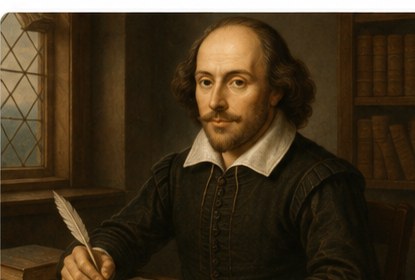
Teacher lesson: Begin with the portrait and a quick discussion of what students already know. Work through the nine panels in order, or choose the sections that suit your class. Teacher answers and the listening script are stored separately.
Teacher AnswersClassic Literature
1 Lesson Goals
William Shakespeare

By the end of this lesson, I will be able to:

  • understand the main ideas and key details in William Shakespeare.
  • learn and use important vocabulary from the lesson.
  • use the lesson language in speaking or writing.
Start here: What do you already know about this topic? Tell a partner one idea.
2 Reading

Before you read: What do you already know about Shakespeare?

William Shakespeare was an English playwright, poet and actor. He was born in Stratford-upon-Avon in 1564. His exact birthday is not known, but records show that he was baptised on 26 April.

He became an actor and writer in London and was a member of a successful theatre company. Many of his plays were performed at the Globe Theatre.

Shakespeare wrote comedies, tragedies and history plays. Famous works include Romeo and Juliet, Hamlet, Macbeth and A Midsummer Night’s Dream. His stories explore love, jealousy, ambition, friendship, family conflict and power.

He died in 1616. His plays are still read, studied and performed around the world.
3 Vocabulary

Match each word to the best meaning.

1. playwright
2. tragedy
3. comedy
4. ambition
5. perform
6. influence
a. a strong desire to achieve something
b. to act or present something to an audience
c. a writer of plays
d. the power to affect people or ideas
e. a serious play, often with a sad ending
f. a play intended to be funny
4 Check Your Understanding

Answer the questions.

  1. Where was Shakespeare born?
  2. What three kinds of plays are mentioned?
  3. Name two famous Shakespeare plays.
  4. What subjects do his stories explore?
  5. Why do you think his work is still popular today?
5 Language Focus

Past simple and past passive

Choose the correct form.

  1. Shakespeare was born / born in Stratford-upon-Avon.
  2. He wrote / was wrote plays for the theatre.
  3. Many of his plays performed / were performed at the Globe.
  4. The First Folio published / was published in 1623.
  5. Audiences around the world still perform / are perform his plays today.
6 Listen & Speak

Listen

Listen to your teacher twice.

  1. Where did Shakespeare spend much of his professional life?
  2. What important theatre was connected with his company?
  3. Which two types of writing are mentioned besides plays?
  4. Why are his works still studied?

Speak

Discuss in pairs or small groups.

  • Why do some stories remain popular for hundreds of years?
  • Which interests you more: comedy, tragedy or history? Why?
  • Can old literature still teach us about modern life?
  • Which Shakespeare play would you most like to see on stage?
7 Use Your English

Something New

Shakespeare Scene Challenge

In groups, choose one situation. Create a 30–45 second mini-scene. The class guesses the theme.

A. Two young people are in love, but their families strongly disagree.

B. A leader wants more power and makes dangerous choices.

C. Two people misunderstand each other and everything becomes confusing and funny.

Choose a theme: love, ambition, conflict, misunderstanding or another idea.

Write

Write 100–120 words on one topic.

  • Why can Shakespeare still be interesting to modern students?
  • A modern story with a Shakespeare-like theme.
  • A short review of a Shakespeare play or film version you know.
8 Puzzle or Game
Vocabulary Detective

Choose four words from the Vocabulary panel. Write a short clue for each word without writing the word itself. Swap with a partner and see how many you can guess.

Bonus: Use one of the words in a new sentence.

9 Success Criteria ✓

Tick each statement when you can do it.

  • I can explain the main idea of the lesson.
  • I can use at least three new words correctly.
  • I can complete the language task.
  • I can share an idea in spoken or written English.

One thing I am proud of today:

10 Show What You Can Do
Final challenge: William Shakespeare

Plan: Note your strongest idea, 3 useful words or phrases, and one supporting detail from the lesson.

Respond: Write a short paragraph of 6–8 sentences, or prepare a 45-second spoken response, showing what you learned.

Reflect: Underline the part of your response that best shows your progress.