By the end of this lesson, I will be able to:
- skim an academic text for its main ideas.
- scan for precise evidence and paraphrases.
- answer three common IELTS-style question types.
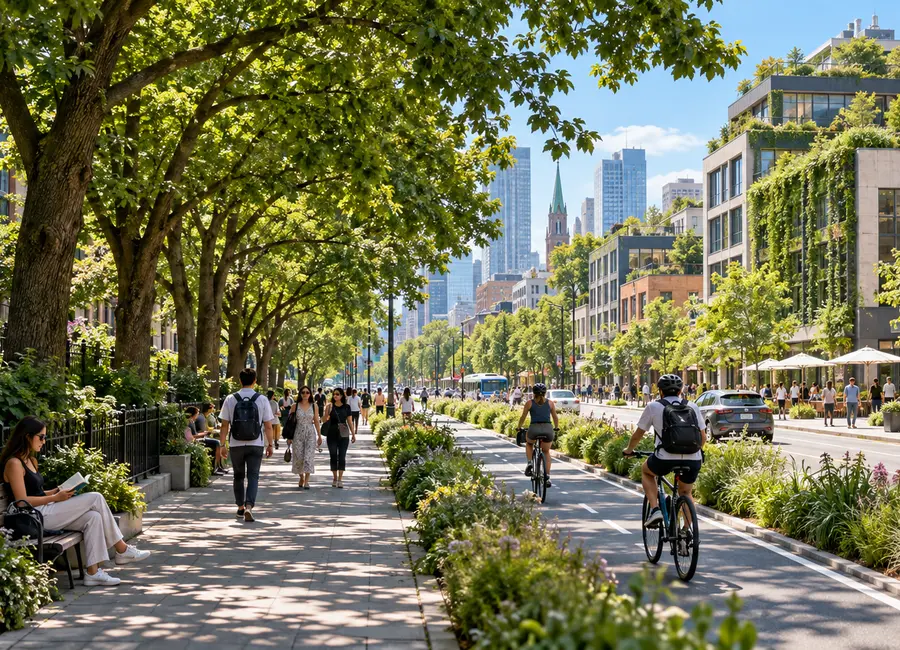
Before reading: How can trees make a city healthier?
Academic reading skills through an original text about greener, healthier cities

By the end of this lesson, I will be able to:
Before reading: How can trees make a city healthier?
Urban Trees and Cooler Cities
A Cities are often warmer than the countryside around them. Roads, roofs and walls absorb solar energy during the day and release it slowly after sunset. This “urban heat island” effect can make hot weather more dangerous, particularly for older people, young children and residents whose homes lack effective cooling. As heatwaves become more frequent, many city governments are searching for methods that reduce temperatures without greatly increasing electricity use.
B Planting trees is one widely discussed response. A broad canopy blocks direct sunlight from pavements and buildings, while water released through leaves cools the surrounding air. This process, called transpiration, works rather like evaporation from wet skin. The benefit is highly local: a shaded footpath may be much more comfortable than an exposed one only a short distance away. Groups of connected trees can also cool a larger neighbourhood more effectively than isolated specimens.
C Yet simply counting newly planted trees can create a misleading impression of progress. Young trees provide little shade, and many fail during their first few years because they receive insufficient water or have too little soil for their roots. A successful programme therefore measures survival, canopy growth and long-term maintenance—not merely the number of seedlings placed in the ground.
D The selection of species also matters. A tree that thrives in one climate may struggle in another, and some species produce pollen that worsens allergies. Others have roots that damage pipes or pavements. Urban foresters increasingly favour a varied mixture of species. Diversity reduces the risk that one disease or insect will destroy most of a city’s trees, while locally appropriate trees are more likely to survive future heat and water shortages.
E Tree cover is rarely distributed equally. Wealthier districts often have older trees, larger gardens and cooler streets, while densely populated neighbourhoods may contain more concrete and fewer parks. Researchers therefore argue that planting decisions should consider exposure to heat, public health and access to green space. Consultation is essential: residents may know where shade is needed most, but they may also worry about blocked lighting, falling branches or maintenance costs.
F Trees cannot solve urban heat on their own. In very dry places, irrigation may compete with other demands for water. Dense planting can also reduce airflow if it is poorly designed. The strongest plans combine trees with reflective roofs, shaded public transport stops, permeable surfaces and buildings designed for passive cooling. Urban trees are therefore best understood not as decoration, but as living infrastructure that requires space, care and decades of planning.
Choose the correct heading for paragraphs A–F. Two headings are extra.
A ___ B ___ C ___
D ___ E ___ F ___
Strategy: Match the whole paragraph—not one repeated word.
Write TRUE, FALSE or NOT GIVEN.
Remember: FALSE contradicts the text. NOT GIVEN means the text does not tell us.
Complete with ONE WORD from the text.
Choose the best answer.
5. The writer’s main argument is that urban trees:
A are mainly decorative.
B should replace other cooling measures.
C are useful infrastructure when carefully planned.
D work equally well in every neighbourhood.
Match each word to its closest meaning.
Paraphrase: “Trees cannot solve urban heat on their own.”
In pairs, choose any answer from panels 4–6. One student states the answer; the other has 30 seconds to locate and read the exact evidence. Swap roles.
Useful evidence language:
Record one strong piece of evidence:
Discuss: Where is shade most needed in your town or city? Which concerns should planners consider?
Write 100–120 words: “City governments should invest more in urban trees.” To what extent do you agree?
Use: although, because, however, therefore.
Reading score: ___ / 17
15–17: excellent · 12–14: strong · 9–11: developing · 0–8: review the evidence
Error review: Choose one incorrect answer. Record the question, your answer, the correct answer and the evidence.
Next step: The strategy I will use next time is: