1Lesson Goals
I will be able to:
- retell the main events.
- use the story’s vocabulary.
- practise the language focus.
- explain an idea with evidence.
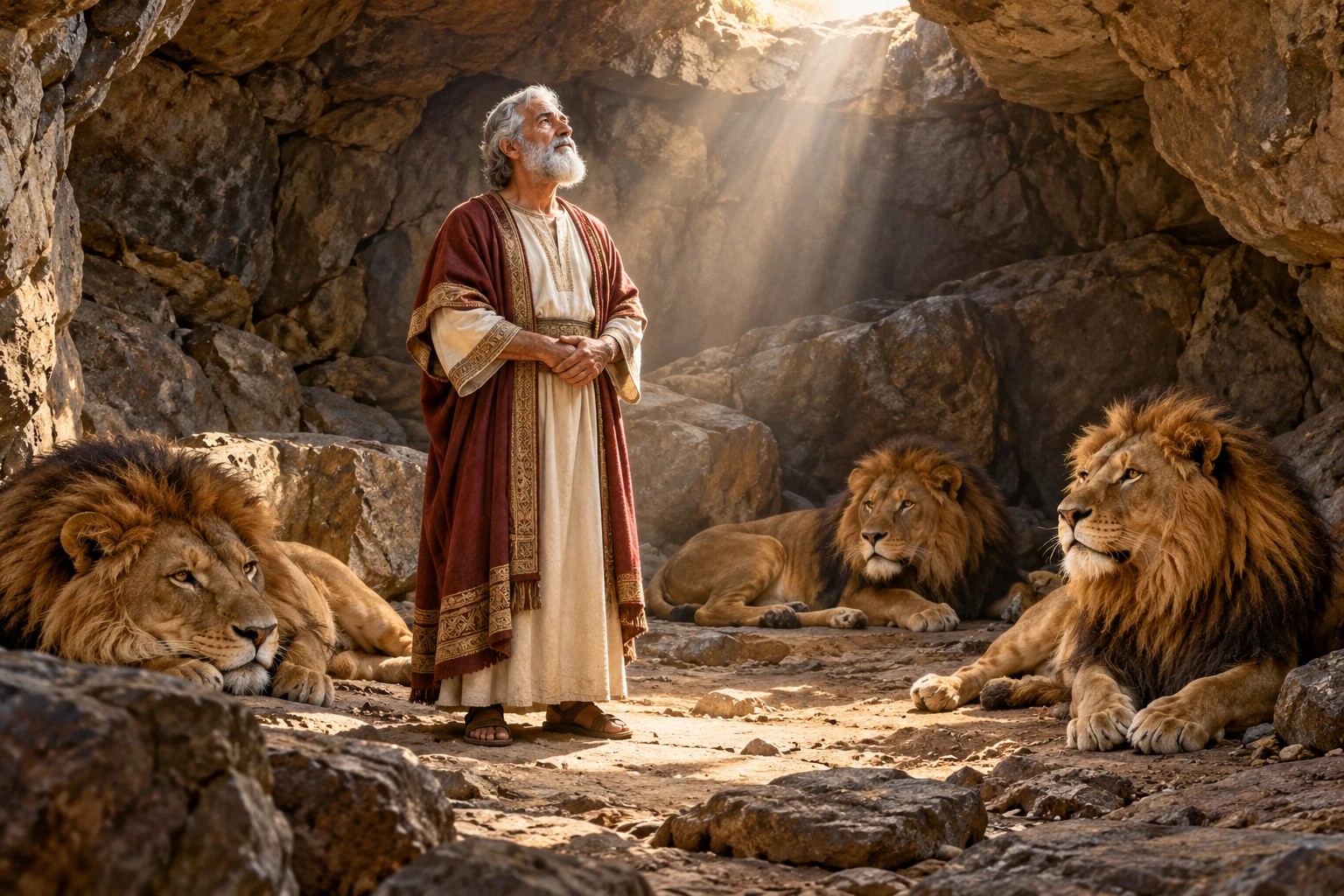
Start here: How does the man appear to feel? What might make this place dangerous?
Faithfulness, courage and difficult choices; practise although.
I will be able to:
Start here: How does the man appear to feel? What might make this place dangerous?
Daniel worked faithfully for King Darius. Other officials wanted to find something wrong with his work, but they could not. They decided to use his prayers to God against him.
They persuaded the king to sign a law. For thirty days, people could make requests only to the king, not to another person or a god. Anyone who broke the law would be put in a den of lions. Although Daniel knew about the law, he continued praying to God three times a day.
The officials reported him. The king wanted to save Daniel, but the law could not be changed. Daniel was put in the lions’ den, and a stone covered the entrance. The king spent a worried, sleepless night.
Early the next morning, the king called to Daniel. Daniel answered that God had sent an angel to shut the lions’ mouths. They had not hurt him. The king was very happy and ordered Daniel to be brought out.
Simplified retelling for English learners; not a direct Bible quotation. Based on Daniel 6:1–23. AI illustration.
Match 1–6 with A–F.
A. the place where you go into something
B. a rule made by those in authority
C. save someone from danger
D. a person with a position of authority
E. loyal and dependable
F. a wild animal’s home
Use two words in your own sentences.
Answer in sentences where you can. Point to evidence in the reading.
Although joins contrasting ideas. Join each pair beginning with Although. Keep both ideas.
Discuss in pairs. Give a reason for each answer.
Useful language: Although… / The evidence is… / Someone could…
You may use imagined examples.
Write 5–7 sentences about a character facing a difficult choice. Use although at least once. You may invent a character.
Plan: Who? What happened? What was the result?
Check capitals, verbs, spelling and punctuation.
Sequence: A. Daniel answered the king. B. The king signed the law. C. Daniel continued praying. D. Daniel was put in the den.
Extra challenge: Explain your answers in complete sentences.
Exit reflection: One thing I learned…
One thing I want to practise…
Explain Daniel’s choice and the result in five sentences. Include although and two details from the story.
Write below or prepare a 45-second spoken response. Use your own words.