1Lesson Goals
I will be able to:
- retell the main events.
- use the story’s vocabulary.
- practise the language focus.
- explain an idea with evidence.
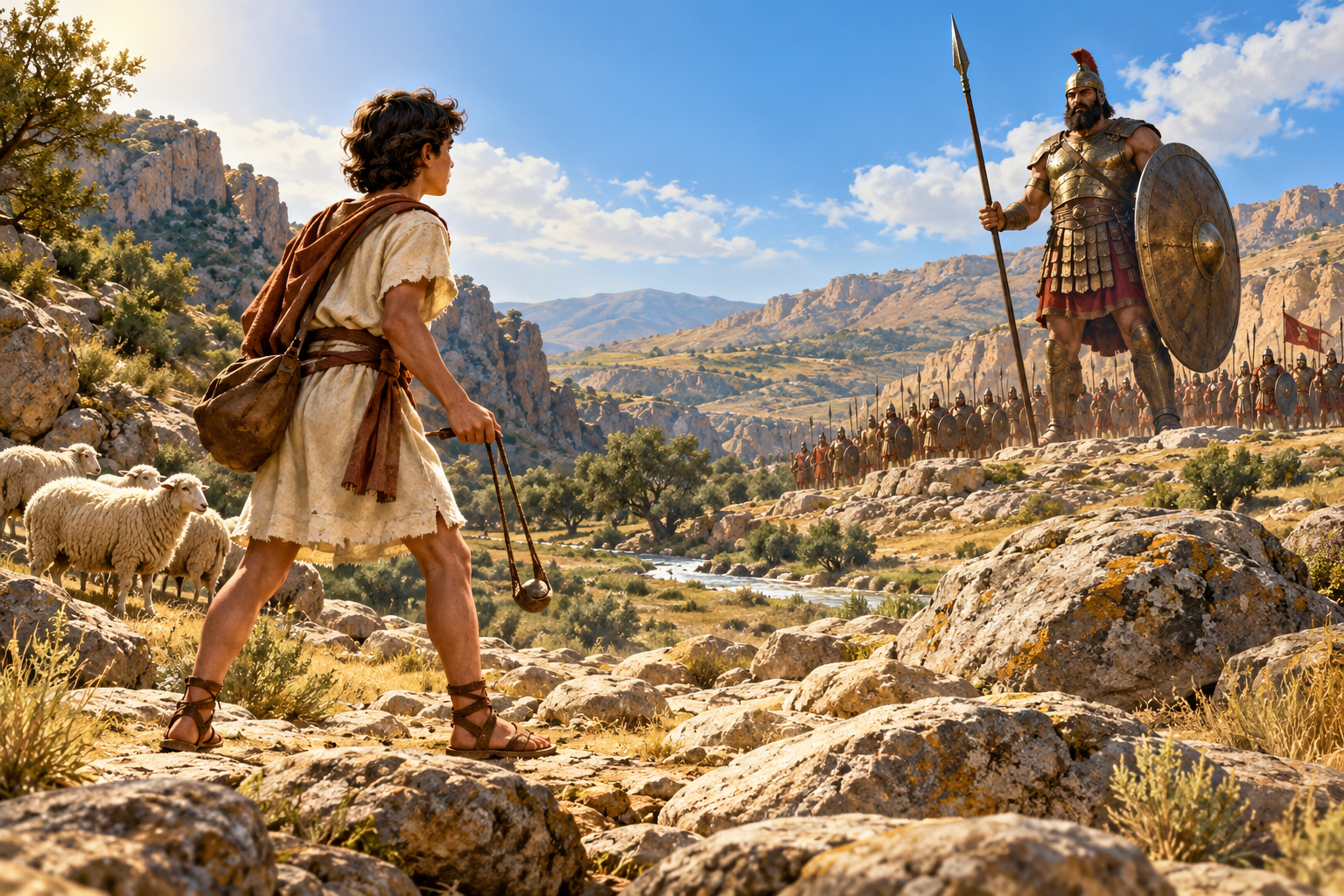
Start here: Look at the picture. What differences do you notice between the two figures?
Courage, faith and preparation; practise descriptions and comparisons.
I will be able to:
Start here: Look at the picture. What differences do you notice between the two figures?
The Israelite army faced the Philistine army. A powerful warrior named Goliath challenged the Israelites. He was very tall and wore heavy armour. The Israelites were afraid.
David was a young shepherd who brought food to his brothers in the army. He heard Goliath’s challenge and offered to face him. David trusted God. He remembered protecting his sheep from a lion and a bear.
King Saul gave David armour, but David was not used to wearing it. He took it off. He chose five smooth stones from a stream and carried his sling. David told Goliath that he came in the name of the Lord.
David used his sling to throw a stone. It struck Goliath, who fell. David defeated him, and the Philistine army ran away. In this Bible story, David’s courage was connected with his trust in God, rather than his size or armour.
Simplified retelling for English learners; not a direct Bible quotation. Based on 1 Samuel 17. AI illustration.
Match 1–6 with A–F.
A. a device used to throw a stone
B. protective clothing worn in battle
C. a person who fights in a war
D. bravery when facing fear
E. a difficult task or invitation to compete
F. a person who looks after sheep
Use two words in your own sentences.
Answer in sentences where you can. Point to evidence in the reading.
Comparatives: adjective + -er + than. Use more with many longer adjectives. Example: A stone is smaller than a shield.
Discuss in pairs. Give a reason for each answer.
Useful language: David trusted… / He prepared by… / I think courage means…
You may use imagined examples.
Write 60–80 words about a character preparing for a difficult task. Use three comparisons and explain what helps the character feel brave.
Plan: Who? What happened? What was the result?
Check capitals, verbs, spelling and punctuation.
Comparison challenge: take turns comparing two classroom objects. Use smaller, bigger, lighter or heavier. Give a point for a complete sentence with than.
Extra challenge: Explain your answers to a partner using complete sentences.
Exit reflection: One thing I learned…
One thing I want to practise…
Describe David and Goliath in 5–6 sentences. Include two comparisons and explain David’s source of courage.
Write below or prepare a 45-second spoken response. Use your own words.