1Lesson Goals
I will be able to:
- retell the main events.
- use the story’s vocabulary.
- practise the language focus.
- explain an idea with evidence.
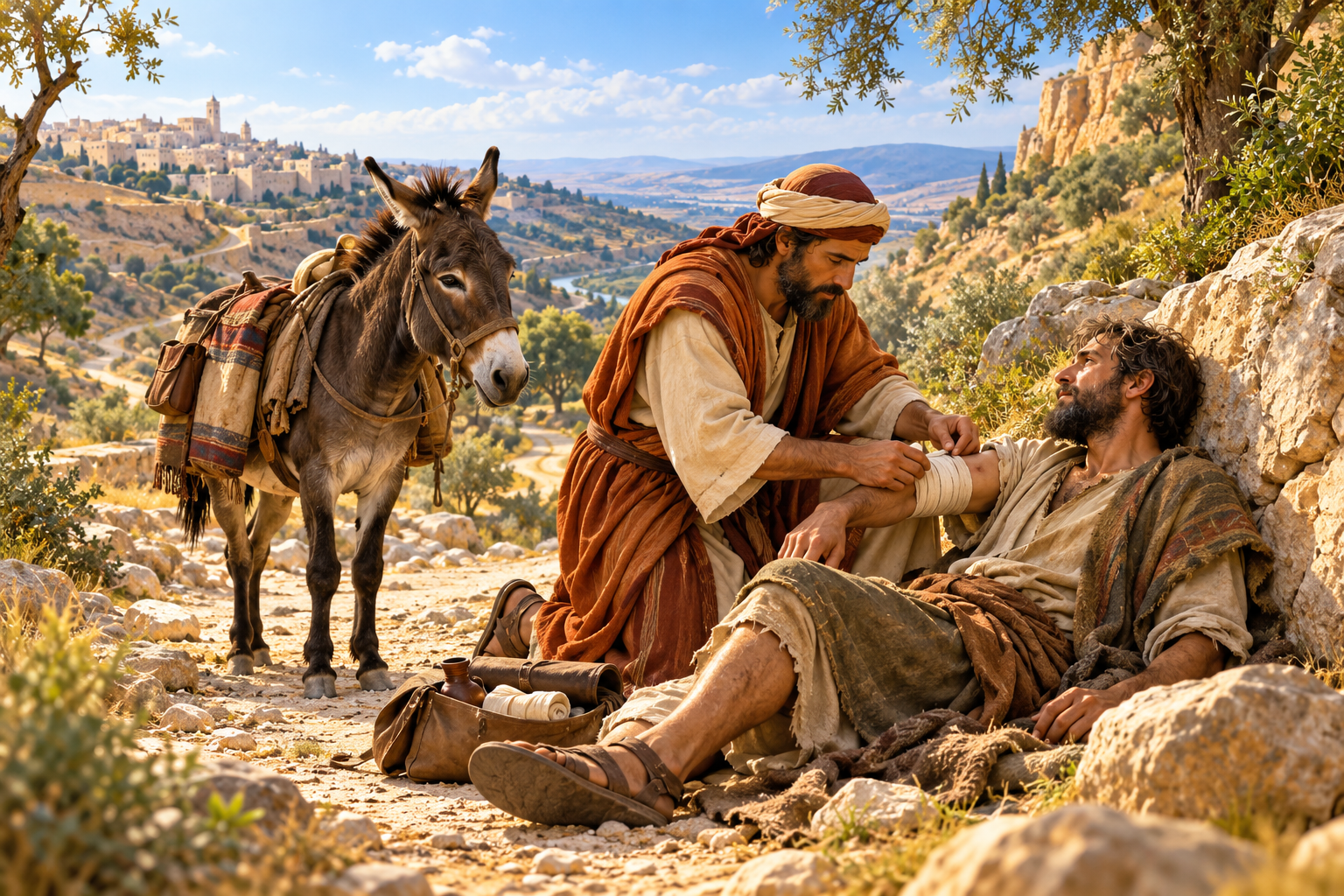
Start here: Look at the picture. What might the traveller need?
Kindness, neighbours and helping others; practise past tense and story order.
I will be able to:
Start here: Look at the picture. What might the traveller need?
Jesus told this story when a man asked who his neighbour was. A traveller was going from Jerusalem to Jericho. Robbers attacked him, took his belongings and left him badly hurt beside the road.
A priest saw the injured man but walked past. A Levite, another religious worker, also passed without helping. Then a Samaritan came along. He felt compassion and stopped. He cared for the man’s wounds, put him on his animal and took him to an inn.
The next day, the Samaritan gave the innkeeper money to care for the traveller. He promised to pay any extra costs when he returned. Jesus asked which person had acted as a neighbour. The answer was the one who had shown mercy. Jesus told the listener to show the same kindness.
Simplified retelling for English learners; not a direct Bible quotation. Based on Luke 10:25–37. AI illustration.
Match 1–6 with A–F.
A. a place where travellers can stay
B. things that a person owns
C. an injury to the body
D. kindness shown to someone in difficulty
E. a person on a journey
F. a feeling that makes you want to help someone who is suffering
Use two words in your own sentences.
Answer in sentences where you can. Point to evidence in the reading.
Past simple: use past forms to tell a finished story. Example: see → saw; stop → stopped.
Discuss in pairs. Give a reason for each answer.
Useful language: I think… because… / A helpful person can… / First…, then…, finally…
You may use imagined examples.
Write 60–80 words about someone helping a neighbour. Use past simple verbs and first, then and finally.
Plan: Who? What happened? What was the result?
Check capitals, verbs, spelling and punctuation.
Put these events in order: A. The Samaritan paid the innkeeper. B. Robbers attacked the traveller. C. The Samaritan cared for the wounds. D. Two people passed without helping. E. The traveller was taken to an inn.
Extra challenge: Explain your answers to a partner using complete sentences.
Exit reflection: One thing I learned…
One thing I want to practise…
Retell the story in 5–6 sentences. Explain how the Samaritan acted as a neighbour.
Write below or prepare a 45-second spoken response. Use your own words.