1Lesson Goals
I will be able to:
- retell the main events.
- use the story’s vocabulary.
- practise the language focus.
- explain an idea with evidence.
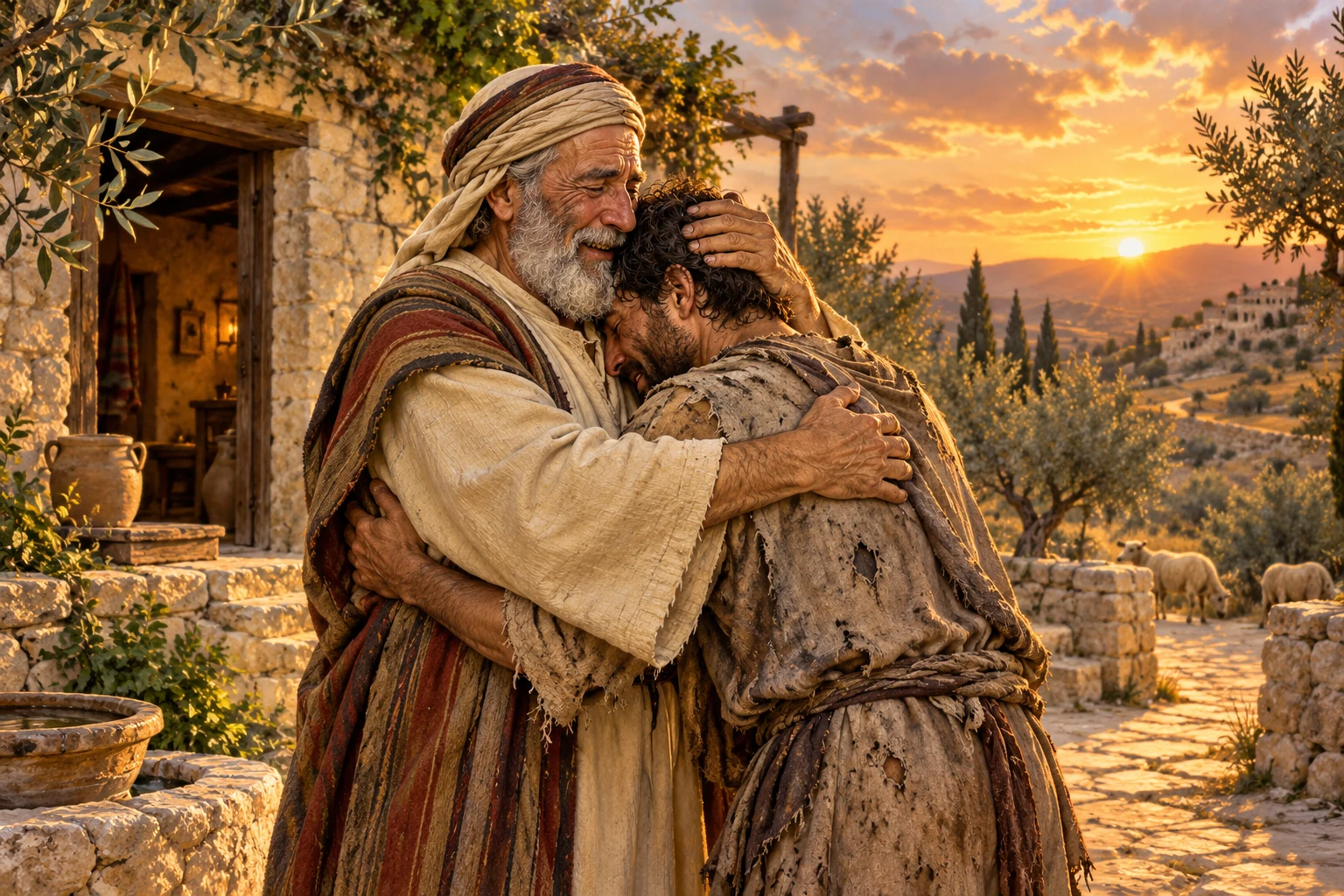
Start here: What might the two people be feeling?
Forgiveness, family and a fresh start; practise sequencing words.
I will be able to:
Start here: What might the two people be feeling?
Jesus told a story about a father with two sons. The younger son asked for his share of the family property. He left for a distant country and wasted his money. Then a famine came, and he had nothing to eat. He took a job feeding pigs.
He remembered that his father’s workers had enough food. He decided to return, admit his wrongdoing and ask to work as a servant. While he was still far away, his father saw him, ran to him and embraced him.
The son admitted that he had sinned. His father asked for a fine robe, a ring and sandals for him. He arranged a celebration because his son had returned.
The older brother was angry and would not go inside. He felt his years of work had not been celebrated. The father went out to speak with him. He said they should be glad because his brother, who had been lost, had returned.
Simplified retelling for English learners; not a direct Bible quotation. Based on Luke 15:11–32. AI illustration.
Match 1–6 with A–F.
A. a serious shortage of food
B. far away
C. hug someone
D. things or land that someone owns
E. show happiness about a special event
F. a person employed to work in someone’s home
Use two words in your own sentences.
Answer in sentences where you can. Point to evidence in the reading.
Use First, Then, Later and Finally to show order. Complete the summary using each word once.
Discuss in pairs. Give a reason for each answer.
Useful language: First… / He might feel… because… / An apology could…
You may use imagined examples.
Write 5–7 sentences about a character who makes a mistake and puts it right. Use three sequencing words. Use an imagined example if you prefer.
Plan: Who? What happened? What was the result?
Check capitals, verbs, spelling and punctuation.
Who is it? A. I returned after wasting my money. B. I ran to welcome my son. C. I was angry and stayed outside.
Extra challenge: Explain your answers in complete sentences.
Exit reflection: One thing I learned…
One thing I want to practise…
Retell the story in six sentences, including both brothers. Use three sequencing words and describe the father’s response.
Write below or prepare a 45-second spoken response. Use your own words.