English Drills
Home › Classic Literature › Moby-Dick

Moby-Dick

Herman Melville · The sea, obsession and responsibility

B1–B250–60 minutesClassic LiteraturePrintable
Teacher note: An original simplified overview, not an extract or a complete retelling. The ending includes a shipwreck and deaths without graphic detail. Distinguish Ahab’s interpretation of the whale from fact. Explain the historical whaling setting; the story is not a modern guide to whales.
Teacher AnswersClassic Literature
1Lesson Goals
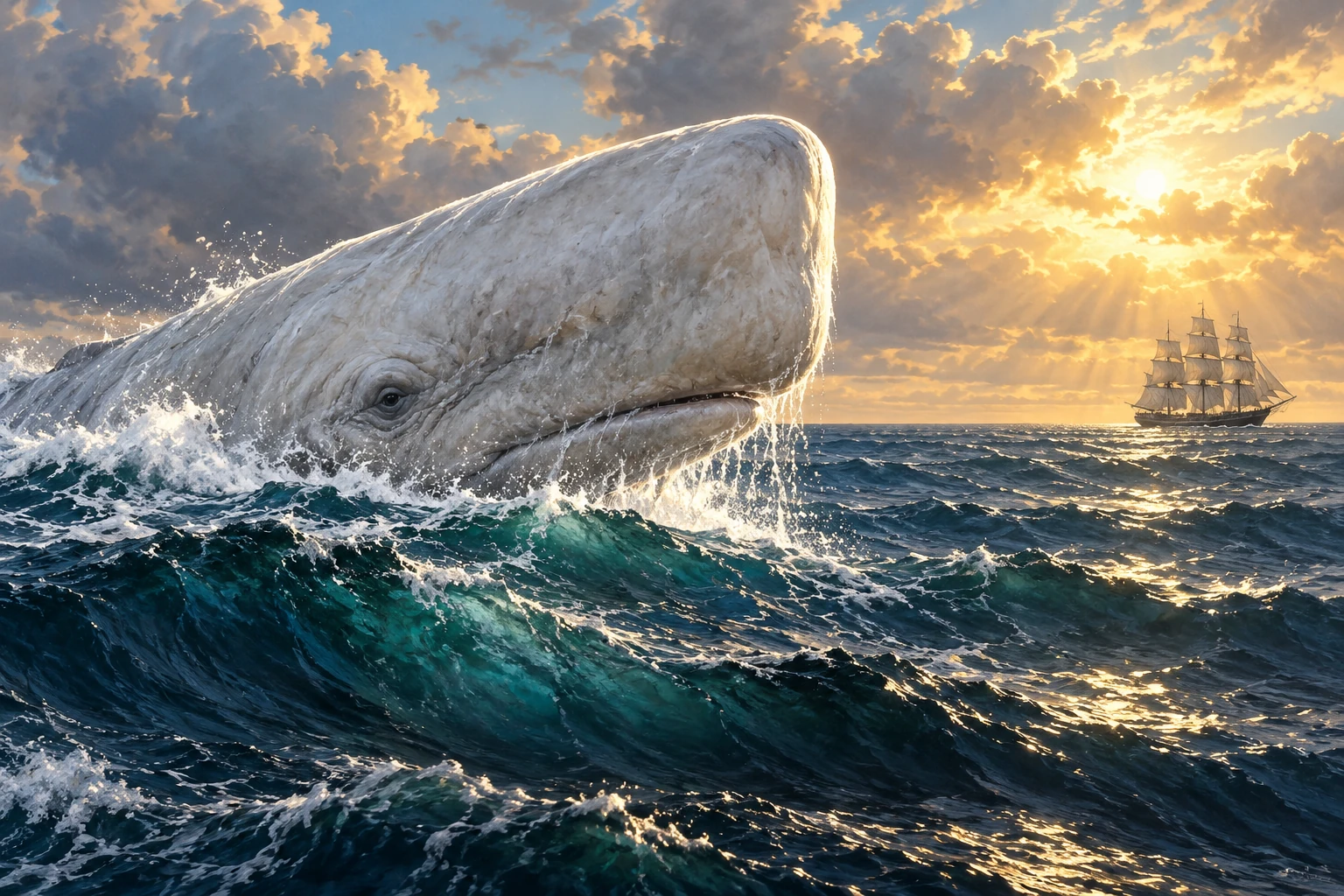
AI illustration of a white sperm whale surfacing in the ocean with a nineteenth-century sailing ship in the distance

I will be able to:

  • summarise the voyage and its ending.
  • use vocabulary about the sea and leadership.
  • describe people and things with relative clauses.
  • discuss ambition and responsibility.

Start here: When might determination become dangerous?

2Read the Story

Herman Melville published Moby-Dick in 1851. Ishmael, the narrator, wants to go to sea. He becomes friends with Queequeg, an experienced harpooner, and they join the crew of a whaling ship called the Pequod.

The captain, Ahab, has lost a leg in an earlier encounter with Moby Dick, a great white sperm whale. Ahab wants revenge. Although the ship’s usual work is hunting whales for oil, he makes finding this particular whale his main goal.

The crew comes from many places and depends on cooperation at sea. Starbuck, the first mate, questions Ahab’s dangerous purpose. However, Ahab remains determined. He treats the whale as a personal enemy and refuses to put the crew’s safety first.

Ishmael describes life aboard the ship and the power of the ocean. His friendship with Queequeg also shows the value of looking beyond first impressions. Their relationship contrasts with Ahab’s narrow focus on revenge.

When the Pequod finally meets Moby Dick, Ahab leads a chase that lasts three days. The whale destroys the ship, and Ahab and the other crew members die. Ishmael survives by floating on Queequeg’s coffin, which has been prepared as a life buoy. Another ship rescues him.

The novel invites questions about obsession, leadership and the limits of human control. Ahab sees meaning in the whale’s actions, but readers need not accept his view. The ocean remains larger than any one person’s plans.

Original simplified overview; not a quotation. Read the original novel. AI illustration.
3Vocabulary

Match 1–6 with A–F.

  1. narrator
  2. crew
  3. revenge
  4. obsession
  5. cooperation
  6. survive

A. working together towards a shared goal
B. to stay alive after danger
C. the people working on a ship
D. a desire to hurt someone because of an earlier injury
E. the person who tells a story
F. a thought or aim that takes over someone’s attention

Use two words in your own sentences.

4Check Your Understanding
  1. Who wrote the novel, and when was it published?
  2. Who tells the story?
  3. Why does Ahab want revenge on Moby Dick?
  4. Who questions Ahab’s purpose?
  5. How does Ishmael’s friendship contrast with Ahab’s focus?
  6. What happens to the Pequod?
  7. How does Ishmael survive?

Answer in sentences. Find evidence in the reading.

5Language Focus

Defining relative clauses identify a person or thing.

The sailor who tells the story is Ishmael. The ship which they join is the Pequod.

Complete with who or which. For this exercise, use only these two words.

  1. Ishmael is the narrator ___ tells the story.
  2. The Pequod is the ship ___ carries the crew.
  3. Starbuck is the first mate ___ questions Ahab.
  4. Moby Dick is the whale ___ Ahab pursues.

Try it: Join with who: Ahab is a captain. He wants revenge.

6Think & Speak

Discuss in pairs:

  1. How is obsession different from healthy determination?
  2. What responsibilities does a captain have towards the crew?
  3. Must readers agree that the whale is Ahab’s personal enemy?

Useful language: A person who… / A goal which… / One responsibility is… / The evidence suggests…

Use evidence and consider more than one viewpoint.

7Use Your English

Write 80–100 words. Choose one:

  • A letter from a crew member asking Ahab to reconsider.
  • A paragraph describing the qualities of a responsible leader.

Use two defining relative clauses and two vocabulary words.

Check sentence structure, capitals and punctuation.

8Puzzle or Game

Match each character with the correct role. Write the pairs.

1. Ishmael · 2. Ahab · 3. Queequeg · 4. Starbuck

A. The first mate who questions the chase.

B. The narrator who survives.

C. The captain who seeks revenge.

D. Ishmael’s friend and an experienced harpooner.

Compare your answer with a partner and explain your choices.

9Success Criteria ✓
  • I can explain the voyage and its ending.
  • I can use three new words.
  • I can form defining relative clauses.
  • I can distinguish Ahab’s view from fact.
  • I can discuss leadership with evidence.

Exit reflection: One idea I understand better…

One thing I want to practise…

10Show What You Can Do

Final challenge: Write 6–8 sentences, or prepare a one-minute spoken response, explaining why Ahab’s goal becomes dangerous. Include two details from the overview, one responsibility of a leader, and two defining relative clauses.