English Drills

Print or save as PDF

Choose Colour, Black & White or Economy / Low Ink. To save a PDF, select “Save as PDF” in your browser’s print window. For two-sided printing, use A4 landscape and flip on the short edge.

Open teacher answers
Home › Themes › The Day Humans First Walked on the Moon

The Day Humans First Walked on the Moon

View saved lessons

A complete B1 classroom lesson with the EnglishDrills 10-panel lesson sequence.

B150–60 minutesHistory & spacePrintable
Teacher lesson: Look at the picture and title. What do you already know about the first Moon landing? Discuss with a partner and write two ideas. Work through the ten panels in order, or choose the sections that suit your class. Teacher answers and the listening script are stored separately.
Teacher Answers

The Day Humans First Walked on the Moon

Name: ____________________________ Date: ________________ Student worksheet · 1 / 2

1 Lesson Goals
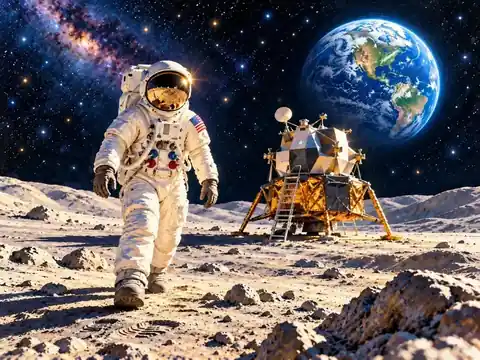
Astronaut on the Moon beside the lunar module with Earth in the background

By the end of this lesson, I will be able to:

  • understand the main events of the Apollo 11 Moon landing.
  • use key vocabulary connected with space exploration.
  • talk and write about an important historical achievement.
Remember and Use — 3 minutes
Say three words from last time. Use one in a sentence. Ask a partner one question. Check and improve.
First lesson? Use the picture.
2 Reading
Before you read:

Look at the picture. What can you see? What do you think the astronauts were feeling?

On 20 July 1969, millions of people watched as humans landed on the Moon for the first time. The Apollo 11 spacecraft carried three American astronauts: Neil Armstrong, Buzz Aldrin and Michael Collins. Armstrong and Aldrin travelled down to the Moon in a small lunar module called Eagle, while Collins remained in orbit above them. After landing safely, Armstrong climbed down the ladder and became the first person to step onto the Moon. Aldrin joined him soon after. The two astronauts collected rock samples, took photographs and placed scientific equipment on the surface. They spent a little over two hours outside the lunar module before returning to Eagle. The mission showed what careful planning, teamwork and technology could achieve, and it became one of the most famous events of the twentieth century.

Read the additional reading sheet.

Read the text after the two activity pages. Underline details that support your answers.

Words and ideas to remember
3 Vocabulary
Words: spacecraft · lunar module · orbit · surface · achievement

Write a short meaning or example for each word.

spacecraft –

lunar module –

orbit –

surface –

achievement –

4 Check Your Understanding

1. On what date did Apollo 11 land on the Moon?

2. Which two astronauts walked on the Moon?

3. What did Michael Collins do during the landing?

4. Name two things Armstrong and Aldrin did on the Moon.

5. Why do you think the mission became so famous?

5 Language Focus

Complete each sentence using the correct past simple form.

1. Apollo 11 (carry) three astronauts.

2. Armstrong and Aldrin (land) on the Moon.

3. Collins (remain) in orbit.

4. The astronauts (collect) rock samples.

6 Listen & Speak

Listen

Listen to your teacher. You will hear the text twice. Answer the questions.

1. What was the name of the lunar module?

2. Who stayed in orbit?

3. What did the astronauts collect?

4. What helped make the mission successful?

Speak

Discuss with a partner.

Why do people explore places that are difficult to reach?
• Which part of the mission seems most challenging?
• Would you like to travel to the Moon? Why or why not?

The Day Humans First Walked on the Moon — continued

Name: ____________________________ Date: ________________ Student worksheet · 2 / 2

7 Use Your English
8 Puzzle or Game
Mission Order

Write these events in the correct order: return to Eagle · collect rock samples · land on the Moon · Armstrong steps onto the surface · Collins remains in orbit.

Order:

9 Success Criteria ✓

Tick each statement when you can do it.

  • I can explain the main events of the Moon landing.
  • I can use at least three new space words correctly.
  • I can use the past simple to describe the mission.
  • I can share an idea about space exploration.

One thing I am proud of today:

10 Show What You Can Do

Check: Use three lesson words. Check the language focus, capital letters and full stops.

Improve: Choose your response from panel 7. Check it and write an improved version here. For a longer response, use the space below or another sheet.

Share: Tell a partner one thing you can now say. Reflect: What did you improve?

The Day Humans First Walked on the Moon — Reading

Before you read:

Look at the picture. What can you see? What do you think the astronauts were feeling?

On 20 July 1969, millions of people watched as humans landed on the Moon for the first time. The Apollo 11 spacecraft carried three American astronauts: Neil Armstrong, Buzz Aldrin and Michael Collins. Armstrong and Aldrin travelled down to the Moon in a small lunar module called Eagle, while Collins remained in orbit above them. After landing safely, Armstrong climbed down the ladder and became the first person to step onto the Moon. Aldrin joined him soon after. The two astronauts collected rock samples, took photographs and placed scientific equipment on the surface. They spent a little over two hours outside the lunar module before returning to Eagle. The mission showed what careful planning, teamwork and technology could achieve, and it became one of the most famous events of the twentieth century.

Finished your practice?

When you have finished this activity, mark it complete.

I’ve finished this activity ✓